Category: STEM

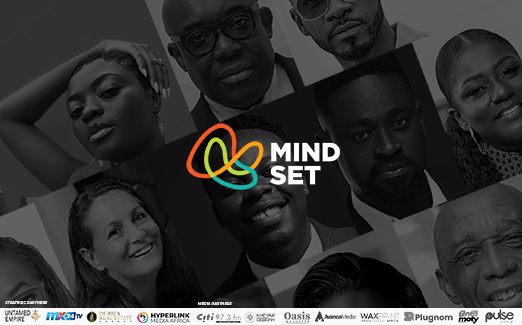
  • TEDxSpintex Event Features 12 Top Mind-blowing Speakers On ‘Mindset’ Happening on August 5th, 2022 – Bright Tenbil

    TEDxSpintex Event Features 12 Top Mind-blowing Speakers On ‘Mindset’ Happening on August 5th, 2022 – Bright Tenbil

    In the spirit of ideas worth sharing, TEDxSpintex will be organizing the rejuvenating TEDx event that seeks to bring people together to share a TED-like experience after 7 years. Individual organizers based on community organize TEDx talks around the world.

    At TEDxSpintex, seeks to drive conversations on ‘MINDSET’. To rethink, learn, unlearn, re-learn experiences in our state as ‘tabula rasa’. The event seeks to delve into topics on art, culture, creativity, activism, governance, social issues, health, finance and education. There would be various activities in the area of creative arts, music, magic, tech metaverse, panel discussions, exhibitions and engagement that is more fascinating.

    This initiative would feature powerful and change-making African as well as global leaders drawn from diverse backgrounds who will speak on issues relevant to African achievement on policy makers, innovative businesses, Diplomacy, fashion, creative art, invention, Diaspora connecting and more as indicated by the Curator; Bright Tenbil. Speakers include, Dentaa Amoateng; CEO of GUBA, Amb. Anne-Sophie; French Ambassador du Ghana, Noel Nii Narku Nortei; Screenwriter, Claudia Lumor; CEO of Glitz Africa, Anthony Dzamefe; Kuukua Eshun; Filmaker, Inventor of Caveman watches, Grace Quarshie; Author, Kobby Kyei; Blogger, Okyeame Kwame; Performing artist, Kobby Andah; MD for Bank of Africa, Moses B. Arthur; An Author and Dr Thomas Mensah; A Famous Inventor.

    The panel discussions also features Vanessa Gyan, A Television Personality, Afia Drah; A Communications Professional, Juanita Naa- Odey Ofori (Dzidudu); A mental Health Advocate, Gifty Oware; Ghana National Service Deputy Director and Lawrence Ameyibor; A Real Estate Investor.

    ‘The speakers were chosen based on innovative ideas to be shared on the theme, and the conversations are mind-blowing’, Bright Tenbil said.

    TedxSpintex would be held on Friday, 5th August, 2022 at the Untamed Empire starting 6pm till 10pm. Attendees and partners can register or visit tedxspintex.com for all enquiries.

    This is a Hyperlink Africa Production.

    About TEDx, x = independently organized event

    In the spirit of ideas worth spreading, TEDx is a program of local, self-organized events that bring people together to share a TED-like experience. At a TEDx event, TED Talks video and live speakers combine to spark deep discussion and connection. These local, self-organized events are branded TEDx, where x = independently organized TED event. The TED Conference provides general guidance for the TEDx program, but individual TEDx events are self-organized. (Subject to certain rules and regulations.)

    About TED

    TED is a nonprofit organization devoted to Ideas Worth Spreading, usually in the form of short, powerful talks (18 minutes or fewer) delivered by today’s leading thinkers and doers. Many of these talks are given at TED’s annual conference in Vancouver, British Columbia, and made available, free, on TED.com. TED speakers have included Bill Gates, Jane Goodall, Elizabeth Gilbert, Sir Richard Branson, Nandan Nilekani, Philippe Starck, Ngozi Okonjo-Iweala, Sal Khan and Daniel Kahneman.

    TED’s open and free initiatives for spreading ideas include TED.com, where new TED Talk videos are posted daily; the TED Translators Program, which provides subtitles and interactive transcripts as well as translations from thousands of volunteers worldwide; the educational initiative TED-Ed; the annual million-dollar TED Prize, which funds exceptional individuals with a “wish,” or idea, to create change in the world; TEDx, which provides licenses to thousands of individuals and groups who host local, self-organized TED-style events around the world; and the TED Fellows program, which selects innovators from around the globe to amplify the impact of their remarkable projects and activities.

    Follow TED on Twitter at http://twitter.com/TEDTalks, on Facebook at http://www.facebook.com/TED or Instagram at https://instagram.com/ted.

  • List of The Top 15 Tech Hubs in Ghana

    List of The Top 15 Tech Hubs in Ghana

    The world is changing each day because of technology. For example, how we used to communicate with our relatives outside Ghana in 2000 is not the same as today.

    According to our older relatives and what we have read in some books and watched in movies before you could speak to your relatives outside in the olden days, you had to write a letter, post the later, wait for the letters to accumulate for it to be sent.

    Once the letters were sent, the person had to go and check his/her mailbox, read the letter, reply, send it, and wait for the same process over again. But now, with just a tap of a button, you can chat with your relatives outside for as long you want to.

    All these changes were made possible through technology. In Ghana, there are some institutions that are constantly helping Ghanaians and Ghanaian startups and businesses grow with the use of technology.

    Usually, we refer to them as Tech Hubs and in this guide, we are going to briefly look at some of the top 15 Tech Hubs in Ghana, their location, and you can get in touch with them.

    What is a Tech Hub?

    Before we delve into the top 15 Tech Hubs in Ghana, let’s look at some of the definitions of a tech hub.

    A tech hub is a physical space-a city, a suburb, or just suite of offices – which has developed to help technology startup companies succeed – IG Global

    A tech hub is a community that promotes innovation for technology-based companies – Seneca One

    A tech hub is basically a physical space, whether a city or suite of offices, that fosters innovation for technology startup companies – African Vibes

    In all these definitions, we can see that are repetitions of some terms, i.e., innovation, technology, startups, businesses. Simply put, a tech hub is any place where innovation is promoted for companies or startups in the technology space.

    List of The Top 15 Tech Hubs in Ghana

    In Africa, Ghana is among the second-tier ranked countries when it comes to tech hubs. This is because there are about 25 tech hubs in the country.

    Other countries like Egypt, South Africa, and Nigeria are ranked Tier 1 since they have over 56, 80, and 85 tech hubs respectively.

    In no particular order, below are the top 15 tech hubs in Ghana.

    1. Ghana Tech Lab

    Ghana Tech Lab is an open collaboration tech space for competent digital skills training, seeding innovations, and growing startups. Ghana Tech Lab is a joint venture between Innohub Ghana and Kumasi Hive under the E-Transform Project of the Ministry of Communications and funded by the World Bank.

    All the programs provided by the Ghana Tech Lab focuses on providing a fertile farm for innovative promising startups in Africa, early-stage investments for promising startups in Africa, and the provision of competent digital training that impels the creation of a highly-skilled digital workforce/human capital.

    The goal of the Ghana Tech Lab is to become the platform for digital innovations in Africa and beyond. The programs and curriculum are designed to make your idea a product/solution that addresses a situation in society.

    Over the years, over 6019 people have been trained across Ghana, 619 jobs created, 78 startups incubated, and 32432 overall applications.

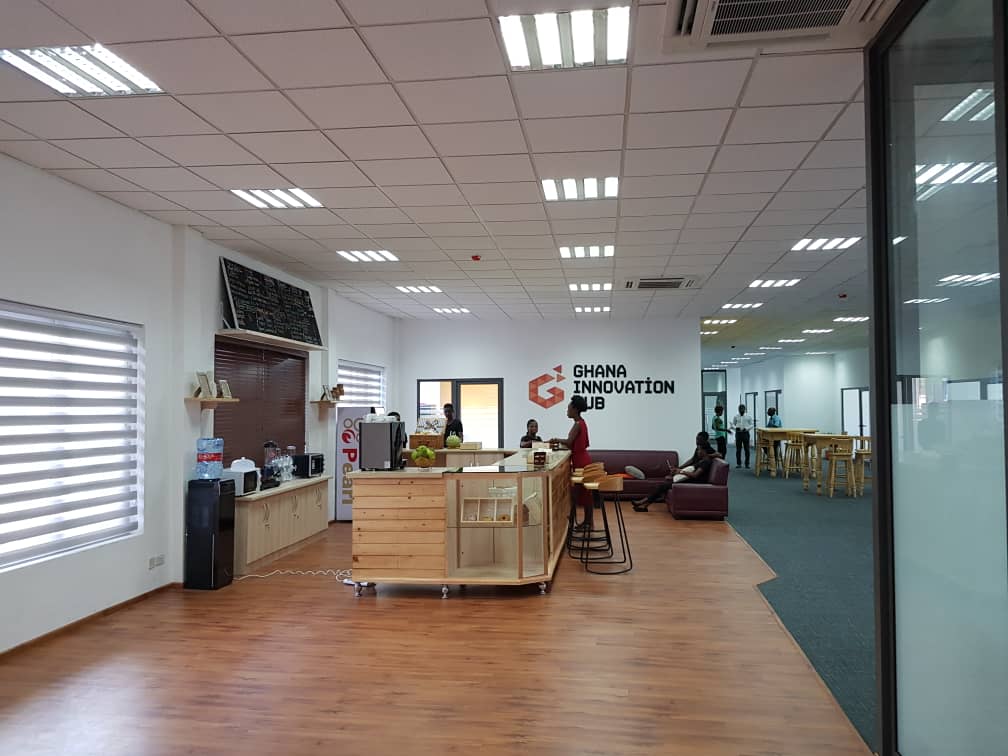
    2. Ghana Innovation Hub

    The Ghana Innovation Hub is located in Accra and runs a program that aims at improving businesses using technology. In this program, businesses are provided with innovative assistance, working space, business development services, access to investment, business support, events, and training spaces, coworking space, etc.

    All they seek to achieve is to help businesses in Ghana with Innovative ways to grow and scale up their businesses. You can visit their website to find out more.

    3. MEST

    Meltwater Entrepreneurial School of Technology (MEST) is one of the biggest and most popular tech hubs in Ghana. Located in East Legon, Accra, MEST is a tech hub that does not only serves startups and businesses in Ghana but almost across the entire African continent.

    Just as the name suggests, MEST takes in students with little or no experience and trains them to become entrepreneurs in the tech ecosystem. Most of the popular Ghanaian tech startup founders passed through MEST where they have received seed funding to kickstart the business.

    Apart from the funding, participants are equipped with the skills, mindsets, resources, and experience needed for their various businesses. Some of the companies they were born by MEST include Zuri, Buildpolis, Complete Farmer, BezoMoney, etc.

    4. Innohub

    Like most of the already mentioned tech hubs, Innohub is also one of the biggest tech hubs in Ghana. Their main motto is “bridging the gap between SMEs and impact investors”.

    Innohub provides a program that links small and medium enterprises with the tools, skills, training, and investors they need to grow their businesses. Participants are supported through various aspects like business strategies, capitals, training programs, market research, market entry support, accelerations services, etc.

    5. Impact Hub

    The Impact Hub is also one of the biggest tech hubs in Ghana that has nurtured some of the biggest startups in Ghana. They provide a program that nurtures innovators and entrepreneurs with the inspiration to grow and build successful businesses in Ghana.

    There are coworking spaces, acceleration programs, private offices, boot camps & training sessions, mentorships from experts, and other opportunities for participants to build and grow their businesses with all the experience they need.

    6. Kumasi Hive

    Kumasi Hive is one of the few tech hubs located outside the capital Accra. It is located at the second biggest commercial town in the country, Kumasi (precisely Kentinkrono), and has trained several founders to build their businesses.

    They run a business incubation program that helps businesses with high potential to grow and scale up their operations. People who take part in this program have access to consultations, coworking space, technical assistance, networking opportunities, and many others.

    7. Growth Mosaic

    Growth Mosaic offers a program for early-stage and high-potential startups by helping them to make a positive impact in the industry they operate in. Growth Mosaic is located in Accra.

    There are acceleration services, business strategies, relationship-building opportunities, business modeling and forecasting, investment, and several other opportunities available for participants. For more information, you can visit their website.

    8. HOPin Academy

    Whenever we talk about tech hubs in Ghana, the main attention is focused on Accra while little attention is given to those in the Northern part of the country. HOPin Academy is a tech hub located in Tamale, Northern Region.

    They host a corporative entrepreneurship program that provides support for founders to bring disruptive change in the industry with the help of technology. Participants are provided with incubation and acceleration services together with digital skills, market entry support, finance and capital, and others.

    9. iSpace

    iSpace is a tech hub located in Accra which provides tech startups and businesses with tailor-made programs. Tech founders are supported to go from the ideation stage through to the incubation stage.

    iSpace provides its participants with startup business support, educational resources, tailored business curriculum, access to training and events, access to financial support, etc.

    10. Kosmos Innovation Centre

    Turning a business idea into a reality is the dream of most people and the Kosmos Innovation Centre is one of the places in Ghana to do that. They offer a business program where prospective entrepreneurs are being invested in for the success of their businesses.

    Mentorship, business support, seed funding, training, business talks, networking, connection building, and many other amazing opportunities are available for participants of this program.

    11. SFAN

    SFAN runs a business program that unlocks the potential of young African entrepreneurs and helps them fulfill their entrepreneurship dreams. Those who participate in this program are provided with several resources and opportunities to bring their dreams into life.

    This program also provides the needed education, skills, events, community, and relationship-building opportunities young entrepreneurs need to thrive in their industry.

    12. GHATBI

    GHATBI is located in Apowa and operates on the motto “we grow generational businesses…”. With this in mind, they have created a holistic program that trains and grows entrepreneurs in Ghana.

    According to the information on their website, the mission of GHATBI is to connect industries with agriculture and build & develop organic and healthy quality products for the people of Ghana. You can read more about GHATBI on their official website.

    13. Afri Labs

    Afri Labs is a tech hub located across Africa that motivates more businesses to create tech hubs in the continent. They offer a program that supports founders, entrepreneurs, and innovators with business data, consultation, job-creation opportunities, legal & financial business support, mentorship & guidance, etc.

    14. GNBCC

    The Ghana Netherlands Business and Cultural Council (GNBCC) organizes a program in collaboration with the Netherlands African Business Council. The GNBCC tech hub is located in the capital of Ghana, Accra.

    Businesses who are part of this program are impacted by the joint combination of these two (2) institutions in the field of business development, access to events, travel support, networking opportunities, resources, etc.

    15. Engine Business Network

    The last tech hub on the list is the Engine Business Network. They have a program to help small and medium-size business enterprises by empowering young and women entrepreneurs.

    The mission of the program is to build transformational entrepreneurs who have the potential to develop sustainable economic development in Africa.

    Conclusion

    Africa is seen as one of the continents with the least advancements in technology, but gradually the continent is growing. With some of the tech hub’s main aim to grow the creation of businesses in the tech space, the continent has a promising future.

    This article has outlined some of the top tech hubs in Ghana, there are several others that we couldn’t cover in this guide but they are all doing an amazing job as well.

  • Opinion: Importance of ICT in Ghana’s Education System

    Opinion: Importance of ICT in Ghana’s Education System

    It is said that the future of every country depends on its youth and that education is the key to success. If these two (2) factors are what will cause a country to move forward, then what can be done to merge these two in order to make Ghana the best in Africa?

    For several years, the attention has shifted from ICT to TVET (Technical/Vocational Education and Training) in Ghana. Most people in high places are of the view that giving more attention to TVET is the way forward for Ghana but in this technology age, this is highly debatable.

    Looking at some of the biggest and most advanced countries in the world, you will realize that most of them have focused more attention on ICT instead of TVET. Of course, TVET was the way forward some few years ago, but now most of the jobs that people with TVET skills were doing can now be done by people with ICT and little or no TVET background.

    For example, some decades ago, car assembling plants were operated mainly by humans and little computers. During this period, people were TVET skills were the ones who were controlling the market. Fast forward to 2022, with the introduction of Artificial Intelligence and other technological advancements, you will agree with me that most companies are now looking for people with ICT backgrounds than TVET.

    This argument in no way considers TVET as unimportant, but on the scale of preference ICT comes before TVET and that is a fact. This opinion guide is going to discuss some of the importance of ICT in Ghana’s education system.

    What is ICT?

    Before I delve deep into the nitty-gritty of this whole discussion, I think is essential for us to explain what ICT is in the first place. ICT is an abbreviation for Information and Communication Technology.

    Generally, there is no specific definition for ICT but it can be defined as “all the devices, networking components, applications, and systems that combined allow people and organizations (i.e., businesses, non-profit agencies, governments, and other enterprises to interact in the digital world.” – Tech Target

    Mostly, ICT is used interchangeably with IT (Information Technology) but there is a clear distinction between the two. IT is a sub-component of ICT whereas ICT is the broad umbrella that covers other subcomponents.

    What Are The Components Of ICT?

    The field of ICT is a fast-growing space and as such, develops as time progresses. This makes it a bit difficult to list all its components since it keeps growing day in and day out.  But basically, the main components of ICT are Software, Cloud Computing, Internet Access, Data, Communications Technology, Transactions, and Hardware.

    Software

    The software component of ICT involves all the applications and intangible components of the computer system. It is generally classified as applications software and system software. Application software includes all the application programmes you could think of like WhatsApp, Facebook, etc. while system software includes the software that enables a computer system to operate like Android, iOS, Windows, etc.

    Hardware

    What are you using to read this article right now? Yes, your answer is an example of a hardware device. Hardware is simply defined as the physical and tangible components of a computer. For example, mobile phone, laptop, mouse, tablet, monitor, televisions, and every other tangible computer device you can think of.

    Data

    Data is usually defined as an unprocessed fact or figure. But this is for people who are now entering the ICT industry. Once you gain much insight, you will find out that almost everything in this world is data. It is the same data that enables the customs officers at the airport to verify that indeed you are the bearer of the passport since your data is stored.

    Importance of ICT in Ghana’s Education System

    According to Swarts (2006), ICTs can be powerful, essential tools for learning: understanding, interpreting and communicating about the real world OR they can be black holes into which we pour our money”. Literally, what this means is that although investing in ICT is a good thing, it could possibly be an avenue for spending money without any good result.

    Yeah, this is true, investing in ICT can be costly and in the early stages can be a bit complicated especially for a country like Ghana where there are several schools in the remote areas. But if we look at it from that angle, then we are not going to invest in anything at all.

    When making an investment for a country, the main goal should be the end results and not the early stages. Obviously, everything in this world is difficult but is not a reason not to do anything. As a child, learning how to walk for difficult but you pulled through and your parents were encouraging you because they were seeing into the future. That’s why now walking is easy for you.

    Ghana gained independence several years ago together with some other countries like Malaysia and Singapore but when you compare the education systems in these countries you will realize that Ghana is lagging behind.

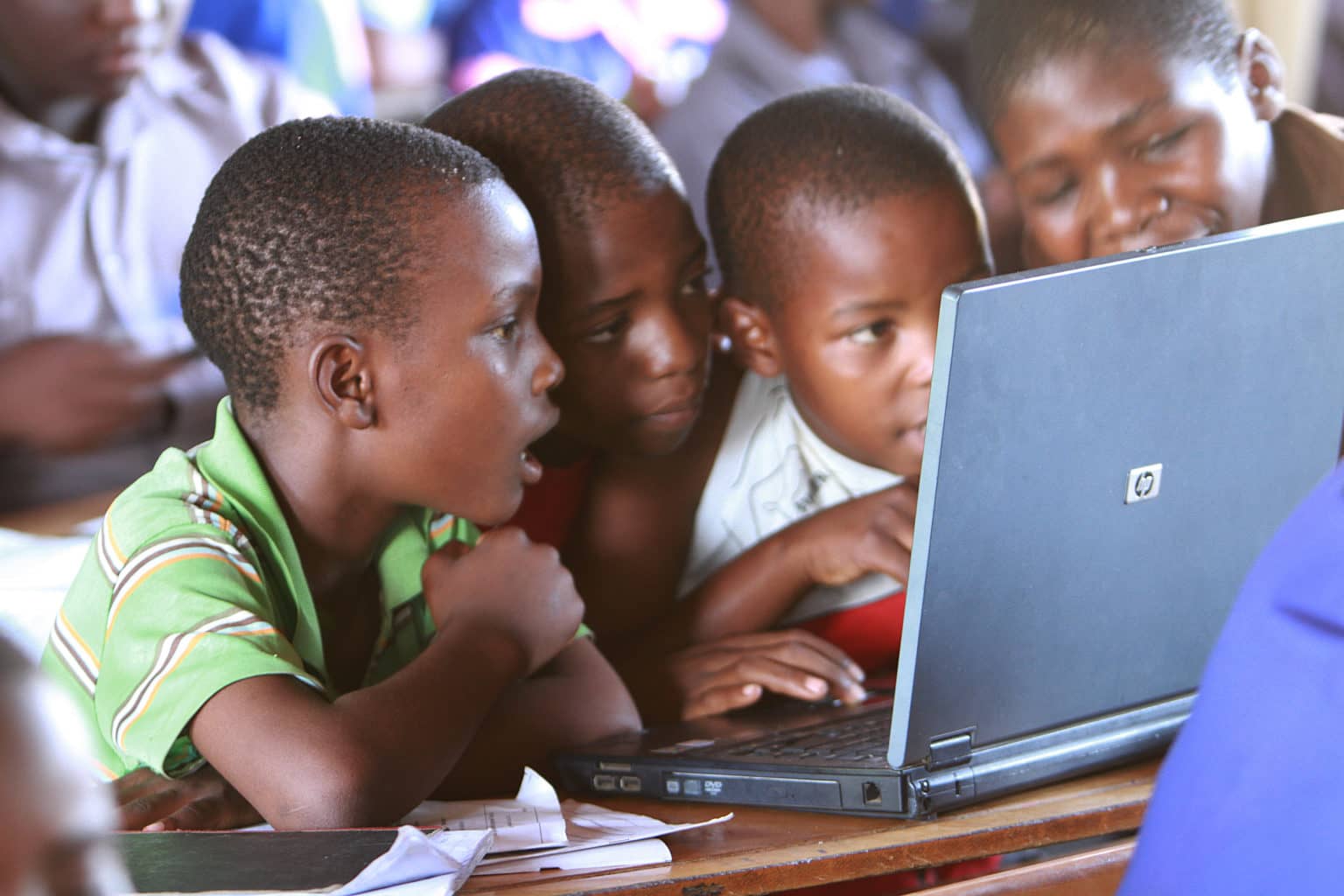
    The COVID-19 pandemic was a wake-up call for the Ghana Education system and the introduction of ICT. As students in other countries were enjoying a smooth transition to the virtual classrooms, students in Ghana were sitting at home doing nothing.

    According to the United Nations Educational, Scientific and Cultural Organization (UNESCO) when ICT is effectively invested into the education system in Ghana, it can:

    • Provide multiple avenues for professional development of both pre-service and in-service teachers, especially through distance education;
    • Facilitate improved teaching and learning processes;
    • Widen the traditional sources of information and knowledge;
    • Reach student population outside traditional education system;
    • Increase opportunities for more student-centered pedagogical approaches;
    • Promote inclusive education by addressing inequalities in gender, language, disability;
    • Provide for flexibility of delivery, etc.

    To add to this, ICT education is more of skill-based learning than traditional learning courses. This way, open completion of school students will have a skill that they can look to find a job in today’s digital world rather than add to the list of employed graduates.

    What’s The Way Forward

    Ghana gained independence over 60 years ago and still, it is lacking some of the basic developments it deserves. Every time we talk about developments in Ghana, the attention is centered on the fact that we have no money, but instead of looking for sustainable ways to generate the money here, we are always consulting to borrow.

    ICT is the reason why some of the biggest countries in the world are what they are today. Ghana can also become big if only we are willing to invest at the right places. There are several consultants available to help Ghana improve its ICT education.

    Government can partner with these consultants and agencies to make this happen. If we are able to do this, Ghana will be ranked among the top countries in the next 10 to 20 years.  

  • #GH4STEM TOP 100 Teacher: Linda Nana Korkor Kyeremanteng – St. Peter and Paul JHS

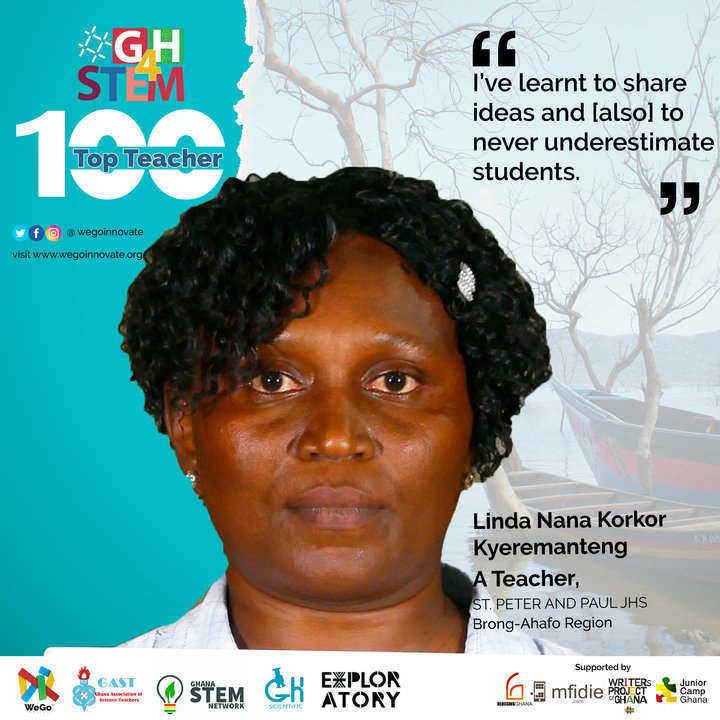
    #GH4STEM TOP 100 Teacher: Linda Nana Korkor Kyeremanteng – St. Peter and Paul JHS

    Linda Nana Korkor Kyeremanteng came to teaching in a rather unusual and round-a-bout way. She had considered Town Planning and Nursing as prospective careers, and even wrote the entrance exam to start training to be a nurse at the Okomfo Anokye Teaching Hospital. But something bizarre happened. When the results were released, she took the overall second place, and was asked to come along with her parents for her prospectus. However, when they arrived, her name was nowhere to be found on the list. Being determined to be a nurse, she stayed at home for five years while trying to achieve this goal. Eventually, her mother, who was a single mother, baker, and owner of two businesses, prepared other plans for her.  Linda recalls the incident with some humour: “My mum one day asked for my passport picture, deceiving me that it was meant for a passport, not knowing that she was applying for me at the training college. And so, fortunately or unfortunately, I was called for an interview and my future dream of becoming a nurse changed to teaching.” Once on that track, Linda did not look back. She went on to acquire a Diploma in Education, and topped it up with a degree from the University of Education, Winneba.

    Linda has now been teaching for the past 17 years. Presently, she teaches one hundred and fifty-five students in Junior High School. When she was informed about the JUNEOS challenge, she was very excited and quickly began preparing her students, who were equally excited. They met to discuss the work and to practice their experiment once a week, on Fridays. The experiment that they chose for the JUNEOS Challenge was based on an experiment that her students had seen. After many improvements, their final experiment involved the use of baking soda, a balloon, and a plastic bottle to make a homemade fire extinguisher.

    Ms. Kyeremanteng has always loved science even though she studied Arts in senior high school. She has always enjoyed watching the National Math and Science Quiz. What she enjoys most  about teaching STEM is that it keeps her abreast with new developments in science. She explains that she enhances her knowledge by reading textbooks and conducting experiments.

    Linda feels that the opportunity and responsibility of training children especially young girls is a key motivating factor in her profession.  As a result of this, she is very happy with the JUNEOS Challenge. “It has made my teaching more practical” she says, adding, “And the fact that it’s practical gives the students the opportunity to learn new things.”  She has also learnt to share ideas with others and also to never underrate or underestimate her students. She encourages all teachers to never give and wants them to teach wholeheartedly. She says, “’For our reward is in Heaven not on this earth, so no matter how difficult it is, we should fight on; one day we will become winners.”


    Kofi Konadu Berko is passionate about education and youth development. He holds a B.A in Adult Education and Human Resource Studies from the University Of Ghana. His works have been  published in the historic Afroyoung Adult anthology titled Waterbirds On the Lakeshore, Adabraka: Stories From the Center Of the World, Tampered Press and the Kalahari Review. He blogs at obolokofi.wordpress.com

  • #GH4STEM TOP 100 Teacher: Josephine Enu Efua Kakra – St. Monica’s Basic A

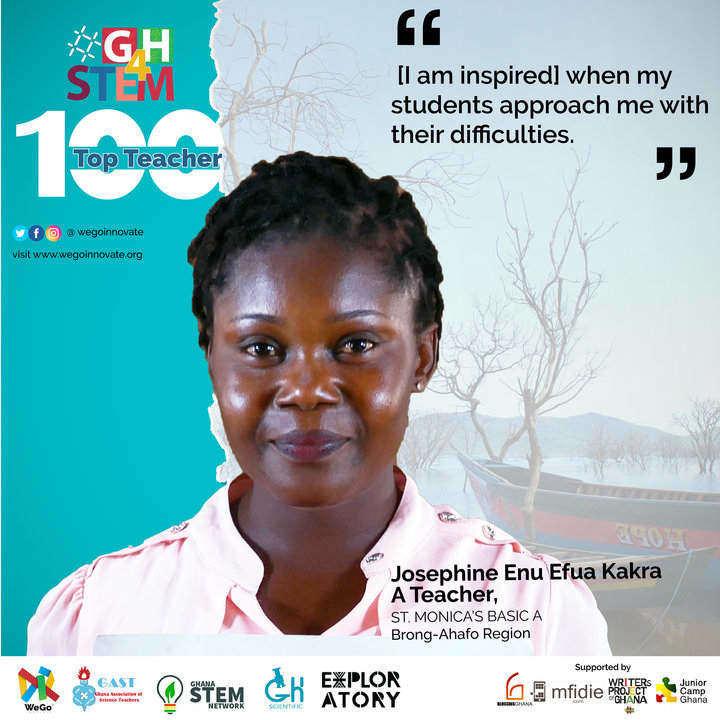
    #GH4STEM TOP 100 Teacher: Josephine Enu Efua Kakra – St. Monica’s Basic A

    Josephine Efua Kakra Enu comes from Saltpond, but she attended primary school in Berekum and received her diploma in Education from OLA Training School before finally obtaining a degree in Education at the University of Education, Winneba.

    When she was younger, Josephine wanted to be an accountant, following in the footsteps of Mr Sekyi, who was her accounting teacher in senior high school. She admired him due to his appearance and his good teaching skills. Being an enterprising and pragmatic person, she does not like being idle and has even engaged in petty trading, before settling on teaching as a profession. She figured that this profession would allow her to make an impact on others, perhaps, recollecting the impact that Mr Sekyi had on her life in senior high school.

    As of 2019, Josephine has been teaching for the past nine years and presently handles a combined class of 120 students. She loves teaching, especially the process of making learning real and interactive for her students. She explains that when her students understand what they have learned in class and are able to demonstrate their knowledge or skill, she is motivated and feels fulfilled as an educator. When her students approach her with questions about the things that challenge or baffle them, she feels that she is doing a good job in teaching because it shows her that they truly trust her guidance.

    Regarding STEM, Josephine says that she has acquired methods of teaching that help her build her students’ interest in science. She works to keep abreast with current happening in STEM  education and improves her knowledge by consistent research. She finds the internet a very good resource, especially the videos on YouTube.

    Josephine was introduced to the JUNEOS challenge by the headmistress of Bess MA school. In choosing an experiment for the challenge, she interacted with her students and other teachers before finally making a choice. The interesting thing is that, prior to the JUNEOS programme, she could not conduct experiments in class with her students, as they did not have the required materials. However this has changed. Because of the support and equipment from JUNEOS, Josephine is now able to conduct experiments during lessons. This has made her teaching and learning sessions practical and interesting.

    Josephine is grateful to the JUNEOS team for their assistance. She hopes that the JUNEOS initiative will help students to achieve much greater heights in STEM.

    When she is not teaching or researching for STEM, she enjoys watching TV. Her favourite celebrity is Wendy Laryea, a newscaster on TV3. As expected, she also enjoys watching the National Maths & Science Quiz.


    Kofi Konadu Berko is passionate about education and youth development. He holds a B.A in Adult Education and Human Resource Studies from the University Of Ghana. His works have been  published in the historic Afroyoung Adult anthology titled Waterbirds On the Lakeshore, Adabraka: Stories From the Center Of the World, Tampered Press and the Kalahari Review. He blogs at obolokofi.wordpress.com

  • #GH4STEM TOP 100 Teacher: Hene Kofi Adu – Bui Power Authority J.H.S.

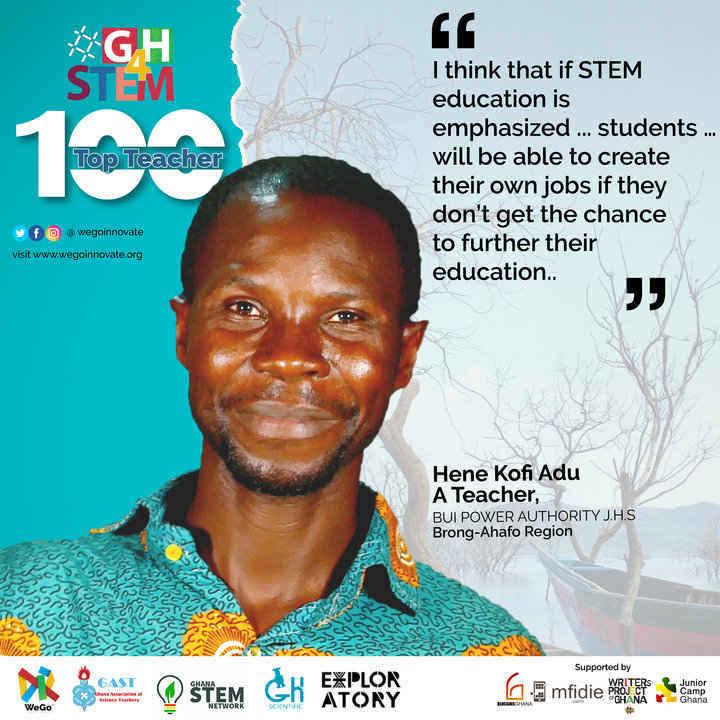
    #GH4STEM TOP 100 Teacher: Hene Kofi Adu – Bui Power Authority J.H.S.

    Mr. Hene Kofi Adu comes from Kwasi Buokroma in the Brong-Ahafo region. He attended Jasikan College of Education and continued his education by taking Management Studies at the Institute of Chartered Management (ICM).  He has been teaching for the past 11 years and currently his students number about seventy-eight.

    When younger, Hene had various ideas about what he wanted to do as a profession. At a point, he wanted to become a pharmacist, and one teacher also asked him to consider law enforcement, so he then wanted to become a police officer. After getting his degree in Education he wanted to become a manager so he furthered his education with Management Studies. However he finally took to teaching. It was his consideration that if things got tough and he could not get a job in the banking sector, he could concentrate on education and still make it. It turns out to have been a good choice, and he has “made it”: Mr. Hene Kofi Adu is currently the headmaster of his school.

    Hene has always loved science, and he was encouraged by his colleague to study science. “I gave it a try and enjoyed it,” he says. He keeps abreast of his STEM knowledge by attending workshops, one of the most recent being the BSTEM workshop held in Kumasi.

    Mr. Adu explains that being an effective STEM educator means that he should make the learner feel involved in the learning process while making the teaching interesting and practical. This allows students to understand what is being taught.

    Hene also believes that STEM education provides future employment opportunities for students and also encourages entrepreneurship. “They will be able to create their own jobs even if they don’t get the chance to further their education,” he says.

    He recounts his most inspiring experience as an educator. It was when two of his students came to him after a lesson. They wanted to create a telescope. Intrigued, he provided them with the required lenses and other materials and challenged them to build it. And truly, they did!  He was impressed. He explains that incidents like this where students demonstrate what they’ve learnt are the high points of his work as an educator.

    For their experiment in the JUNEOS Challenge, he and his students worked on a device that could monitor the level of water in a polytank.

    Mr Hene Kofi Adu believes that he has benefited immensely from the JUNEOS Challenge. He has grown as a teacher and his students have also become eager to learn science and are serious with their studies. The greatest lesson he has learnt as an educator is that “practice, persistent learning and training makes perfect.”

    For leisure, Hene enjoys watching the TV programme Newsfile on Saturday mornings. Though he finds him controversial, his favorite celebrity is lawyer Maurice Ampaw.


    Kofi Konadu Berko is passionate about education and youth development. He holds a B.A in Adult Education and Human Resource Studies from the University Of Ghana. His works have been  published in the historic Afroyoung Adult anthology titled Waterbirds On the Lakeshore, Adabraka: Stories From the Center Of the World, Tampered Press and the Kalahari Review. He blogs at obolokofi.wordpress.com

  • #GH4STEM TOP 100 Teacher: Gifty Tabuaa – Bess M.A. Basic School

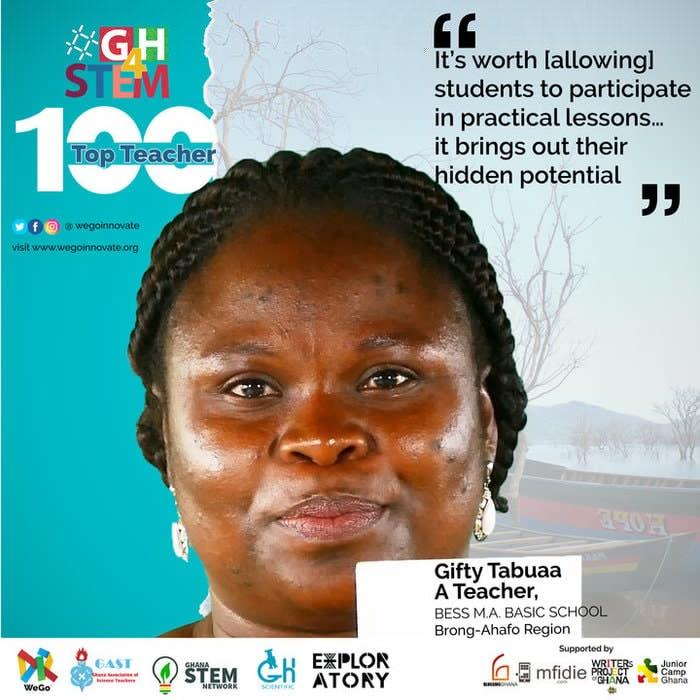
    #GH4STEM TOP 100 Teacher: Gifty Tabuaa – Bess M.A. Basic School

    The first born of six children, leadership and responsibility both came naturally to Gifty Tabuaa. While growing up, Gifty didn’t have a specific career in mind. She just wanted to become a responsible woman when she reached adulthood. She says, “Even though I found myself doing most household chores, as part of my responsibilities as the first child of the family,  and also assisting my mum in trading, my studies were never interrupted.’”

    Gifty Tabuaa has been an active teacher since 2006, and is married with two daughters. Currently, her students number over one hundred and thirty.

    Gifty attended Berekum Senior High School, where she studied science. At a point, after completing school, she applied to work with the Ministry of Health, in particular, the Kintampo Disease Control Unit. Unfortunately, she didn’t make the shortlist so she opted to go to St. Louis College of Education in Kumasi. After a year in school, she realized that she had made a very good choice: teaching was perfect for her. Later she was posted to an Islamic school where she taught Science and Ghanaian language.

    Gifty has always loved science, and in order to improve herself, she attends workshops to enhance her knowledge. After attending a workshop on STEM, she managed to secure laboratory  equipment which has made teaching and learning of science in her school much easier. She describes this as a very motivational.

    Gifty Tabuaa is currently a member of BSTEM. She joined the organisation in order to “market Science and Math to others and to train students  in Science and Maths.” She expects that this will help them realize that Science and Mathematics are not really difficult courses.

    She finds teaching STEM interesting because of the real life application of scientific principles. The availability of Teaching Learning Materials also make STEM lessons practical and facilitates student learning, making the students participate actively during lessons.

    When she was told of the JUNEOS challenge, she decided to focus on an experiment that would be beneficial to most residents of the town who were mainly farmers. “We chose to conduct the experiment on the water holding capacity of the three soil types in order to understand which types of crops to grow in which type of soil,” she says. She and her students selected the appropriate materials and practiced the experiment. According to Gifty, the most important lesson she has learnt from her participation in the JUNEOS Challenge is that it is very important to allow students to do practical experiments by themselves, while supervising. This unearths their hidden talents and potentials.

    Gifty is also grateful to have received the right tools from JUNEOS which she is using to teach effectively. She thinks that every school should participate in the challenge because it motivates students and teachers.

    In the future, Gifty Tabuaa hopes to teach at a higher level of education.


    Article by Kofi Konadu Berko.

    Kofi Konadu Berko is passionate about education and youth development. He holds a B.A in Adult Education and Human Resource Studies from the University Of Ghana. His works have been  published in the historic Afroyoung Adult anthology titled Waterbirds On the Lakeshore, Adabraka: Stories From the Center Of the World, Tampered Press and the Kalahari Review. He blogs at obolokofi.wordpress.com

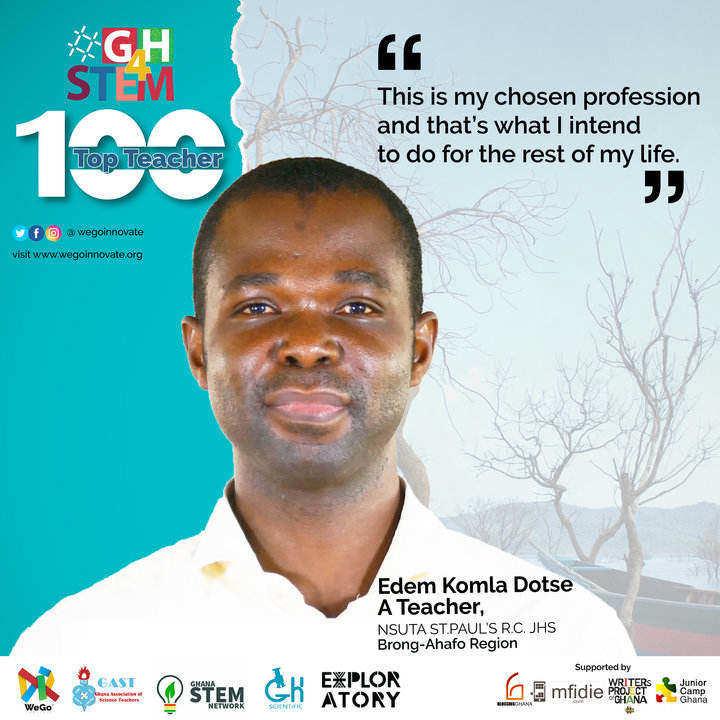
  • #GH4STEM TOP 100 Teacher: Edem Komla Dotse – Nsuta St. Paul’s R.C. JHS

    #GH4STEM TOP 100 Teacher: Edem Komla Dotse – Nsuta St. Paul’s R.C. JHS

    Mr. Dotse firmly  believes that STEM is interesting involves lots of practical demonstrations which makes it enjoyable for students. There was a time when, after a class using cylindrical objects to construct building foundation, some of his students approached him to get materials so they could carry on with some experiments themselves. He also recalls a practical session he had on electrical motors with his students. The next day, one student came to school with a small miniature electric motor he had made based on what he had learnt in class. Mr. Dotse describes these two events as the most inspiring experiences he has had as an educator. It’s no coincidence that during the JUNEOS challenge his students’ experiment involved electrical motor.

    But how did Mr Dotse become a teacher? Initially, he had wanted to be a pharmacist. His desire to become a teacher came later, but not without some resistance from his family, who did not agree with his career choice. In order to please his family, he studied Telecommunications Engineering at a polytechnic. However, he didn’t let his dream of becoming a teacher escape. He eventually persuaded his entire family of the benefits of being a teacher and then went ahead to pursue a degree in Education at the University of Education, Winneba. He has since been teaching for the past nine years, and this is the work he intends doing for the rest of his life. Currently, he has about 150 students. His efforts have been recognized in his district, and in 2013 and 2017, he won an award as the best ICT teacher runner up and winner respectively. Speaking about his profession, Mr Dotse has this to say: “What really motivates me is seeing the students I have taught becoming great and successful people in the society.”

    Edem’s main aim as a STEM educator is to impart knowledge to his students and help them progress in all aspects of their science education. In his teaching model, he achieves this aim by drawing on past learning experiences and knowledge he has acquired from the various workshops he has attended. He is therefore able to give his students the foundation they require so they can build on it when they reach Senior High School. 

    Mr. Dotse learnt about the JUNEOS challenge from the Regional Science Coordinator. His immediate thought was to figure out an experiment which was not only unique and captivating but would also reflect what they learnt in class. Eventually, he settled on the transformation of energy. The experiment conducted by his students involved using electrical motors to demonstrate this concept. The JUNEOS challenge has generated a lot of interest among the students and the school science club membership has increased since then.

    As a child, Edem admired Professor Miriam Ewurama Addy, former host of the National Maths and Science Quiz, which was and remains his favorite TV show. When it comes to music, which he enjoys, Mr. Dotse names Stonebwoy as a favourite due to his versatility.


    Kofi Konadu Berko is passionate about education and youth development. He holds a B.A in Adult Education and Human Resource Studies from the University Of Ghana. His works have been  published in the historic Afroyoung Adult anthology titled Waterbirds On the Lakeshore, Adabraka: Stories From the Center Of the World, Tampered Press and the Kalahari Review. He blogs at obolokofi.wordpress.com

  • #GH4STEM TOP 100 Teacher: Mohammed Mahama  – Tamale International School

    #GH4STEM TOP 100 Teacher: Mohammed Mahama – Tamale International School

    Meet Mohammed Mahama from Tamale International School, who has been teaching for the past twenty years and handles about one hundred and twenty students. Mr. Mahama’s childhood hero was Amitach Bachchan, an Indian actor, whose films he really enjoyed. Mohammed also loves football. His favourite celebrity player is Lionel Messi.

    When Mr. Mahama was younger he wanted to become a businessman. As he grew this changed, and he hoped to be a scientist. What happened in the end, however, was that he studied Agricultural Science in secondary school, after which he enrolled in teacher training college and subsequently became a professional teacher.

    Mr. Mahama draws inspiration from the fact that his students achieve greater heights by learning STEM, and he is encouraged when his students get good results in their examinations. Mr. Mahama explains that one of the benefits of being a STEM educator is that it makes him feel important in the society especially because he identifies each student and guides them through the learning process. Being a STEM educator also makes him keep abreast with new developments in the field. Mr. Mahama is currently a member of the Ghana Association of Science Teachers (GAST). He explains that being with people in the same profession educates and motivates him.

    Mr. Mahama was told about the JUNEOS Challenge by his colleague. He then acquired the apparatus he needed and proceeded to prepare his students for the challenge. Their experiment involved the inflation of a balloon using carbon dioxide produced from a reaction of caustic soda. Mr. Mahama describes his participation in the challenge as a beneficial one. It has given him new teaching methods he can apply to ensure that his lessons are practicals-oriented.

    He hopes that the JUNEOS Challenge will be held annually because it is interesting and educative, and hopes that the JUNEOS Team are able to continue in their endeavor to grow the interest of students in science.


    Stay tuned by following us on Facebook, Instagram and Twitter (@wegoinnovate), Subscribe to our Youtube Channel and be informed!

    Kofi Konadu Berko is passionate about education and youth development. He holds a B.A in Adult Education and Human Resource Studies from the University Of Ghana. His works have been  published in the historic Afroyoung Adult anthology titled Waterbirds On the Lakeshore, Adabraka: Stories From the Center Of the World, Tampered Press and the Kalahari Review. He blogs at obolokofi.wordpress.com

  • #GH4STEM TOP 100 Teacher: Mohammed Hamza – Anbariya J.H.S.

    #GH4STEM TOP 100 Teacher: Mohammed Hamza – Anbariya J.H.S.

    Mohammed Hamza currently teaches over 200 students. He has been teaching for the past decade. He hopes to become an engineering lecturer in the next 5 to 10 years. He enjoys science shows and football matches. His favourite celebrity is footballer Christiano Ronaldo.

    Growing up, most of Mohammed Hamza’s siblings were studying Business at the Senior High School level, so he followed in their footsteps with the hope of becoming a banker. However, after school he taught for a time at a private school. His experience there made him realize his interest in teaching and so he enrolled at the Teacher Training College.

    Mr. Mohammed Hamza loves Science and therefore he continues to improve his knowledge and skills in STEM. He does this by watching science-based TV shows, YouTube and social media. This helps him to keep abreast with things happening around him.

    On what motivates him in his profession, Mr. Hamza explains “The success of my past students keeps me motivated.” In addition, he says that his most positive experience has been his ability to help students understand the reality of concepts taught in class.

    As a STEM educator, he makes an impact in the lives of his students which he believes goes a long way to contribute to the success of the country. He adds that another benefit of  teaching STEM is that it makes it possible for both educators and students to understand technology and their environment. Finally, STEM education builds students’ interest in learning science. Mr. Mahama loves it when he helps students to understand the concept of nature without societal or religious interference.

    When he was told of the JUNEOS Challenge he informed his students, selected a good experiment, and then they began working at their participation. Their JUNEOS Challenge experiment was inspired by the need to teach people in remote areas how to purify their water in order to prevent contraction of water-borne diseases.

    Mr. Mohammed Hamza would not hesitate to participate in the challenge again because it allows him to show how science can be used to solve problems. He believes that this will go a long way to benefit others.

    He hopes that the JUNEOS Challenge is organized annually and publicized to reach a wide audience. He also prays that the JUNEOS team receive attention and support from the government as well. This will enable them to reach students in remote areas. He hopes the JUNEOS Team can guide teachers in particular topics to teach their students so that students can gain more knowledge.

    Mr. Mohammed Hamza’s participation in the Challenge has positively influenced his teaching. He has learnt to improvise with available materials in order to teach effectively. It has also made him pay keen attention to experiments he demonstrates to his students. Most importantly, it has improved his confidence as a STEM educator.


    Stay tuned by following us on Facebook, Instagram and Twitter (@wegoinnovate), Subscribe to our Youtube Channel and be informed!

    Kofi Konadu Berko is passionate about education and youth development. He holds a B.A in Adult Education and Human Resource Studies from the University Of Ghana. His works have been  published in the historic Afroyoung Adult anthology titled Waterbirds On the Lakeshore, Adabraka: Stories From the Center Of the World, Tampered Press and the Kalahari Review. He blogs at obolokofi.wordpress.com